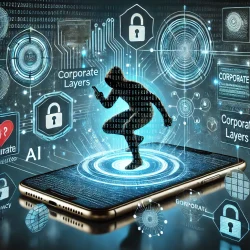
In the ever-evolving world of cybersecurity, artificial intelligence (AI) is both a boon and a bane. While businesses and security professionals have embraced AI for enhancing their security measures, hackers are increasingly harnessing its power to launch more sophisticated attacks.
One particularly vulnerable area is corporate mobile devices. These devices can store and access sensitive corporate data, and have become prime targets for cybercriminals.
How AI is Revolutionizing Hacker Tactics in Corporate Mobile Device Attacks
Here’s how AI is changing the game for hackers targeting corporate mobile devices.
1. Automated Phishing Attacks
Phishing has long been one of the most effective methods hackers use to infiltrate corporate networks, and with the help of AI, these attacks are becoming even more convincing. Hackers now leverage AI algorithms to craft highly personalized and authentic-looking phishing messages, making it harder for employees to distinguish between legitimate and malicious communications.
AI enables attackers to analyze vast amounts of data—such as emails, social media profiles, and public data—allowing them to tailor phishing messages to specific individuals. These AI-generated phishing emails are often indistinguishable from genuine corporate communications, increasing the likelihood of a successful breach.
2. Malware Evolution: AI-Driven Mobile Malware
Hackers are using AI to create more potent and evasive mobile malware. Traditional malware can often be detected by security software through signature-based detection methods. However, AI-driven malware can learn from these detection methods and adapt its behavior to evade detection.
For instance, malware can be programmed to alter its code or hide its activity when it detects that it is running in a sandbox or virtual environment used by security teams for analysis. AI-powered malware can also learn user behavior on corporate mobile devices and only launch attacks during specific times, making it harder to detect and remove.
3. AI-Enhanced Social Engineering
Social engineering attacks rely on manipulating individuals into divulging confidential information. AI is being used by hackers to analyze employee behavior and interactions on social media, emails, and messaging platforms. By understanding communication patterns, preferences, and vulnerabilities, AI can help attackers develop more persuasive messages, increasing the success rates of social engineering attacks.
Imagine an employee receiving a message from what seems like their superior, crafted with the help of AI to mimic their writing style and tone. These types of attacks are not only more personalized but can happen on multiple platforms—including corporate messaging apps on mobile devices.
4. AI-Powered Mobile Device Exploits
Hackers are exploiting AI to scan for vulnerabilities in mobile devices. AI-driven tools can analyze corporate mobile device configurations, security patches, and software versions, looking for weaknesses. Once a vulnerability is identified, AI can assist in automating the process of exploitation, making it quicker and more efficient.
These AI tools also enable hackers to perform “zero-day” attacks, where previously unknown vulnerabilities in mobile operating systems or apps are exploited before a patch is available. The speed and precision with which AI can detect and exploit such flaws make it a formidable weapon in a hacker’s toolkit.
5. Deepfake Attacks
One of the most chilling applications of AI in hacking is the use of deepfakes — AI-generated media that can convincingly replicate voices, images, or videos. Hackers can use deepfake technology to impersonate company executives or key decision-makers, sending fraudulent requests or instructions through mobile devices.
Imagine receiving a voice message from what sounds like the CEO, instructing you to transfer funds or share confidential data. With deepfake technology, this type of impersonation can be convincing enough to fool even the most cautious employees.
6. AI-Driven Network Infiltration
Mobile devices often act as an entry point into broader corporate networks. Hackers are leveraging AI to analyze traffic patterns and detect the weakest points in a network’s defenses. By infiltrating a mobile device, attackers can use AI to pivot from the device to the larger corporate infrastructure, gathering intelligence and identifying further vulnerabilities.
AI can also help hackers stay undetected for longer periods by mimicking legitimate network activity. This allows cybercriminals to quietly exfiltrate data or wait for the right moment to strike.
7. AI-Enabled Credential Theft
Credential theft is a significant threat to corporate mobile devices. Hackers use AI to sift through enormous amounts of data to discover potential login credentials, such as passwords and tokens. AI can automate brute-force attacks, cracking passwords more efficiently by testing countless combinations in a fraction of the time it would take a human.
Moreover, AI can be employed to bypass multi-factor authentication (MFA). For example, AI-driven bots can intercept and replicate mobile-based MFA requests, fooling the system into granting access to sensitive corporate data.
Symmetrium: A Paradigm Shift in Mobile Security
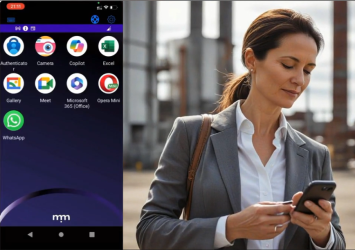
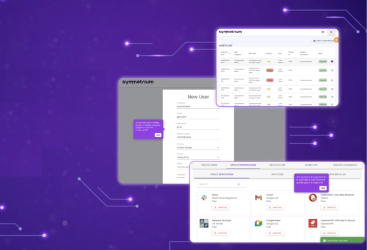
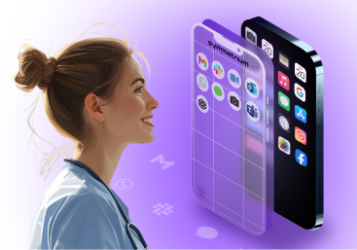
The emergence of AI-powered cyberattacks has prompted a significant reevaluation of conventional security strategies. Unlike traditional mobile device management (MDM) solutions, which focus on securing physical devices, Symmetrium provides a virtual environment where data can be accessed, viewed, and interacted with — without ever physically leaving the company’s secure network. This minimizes the risk of data leaks, theft, or exposure to malware by hackers exploiting AI, while maintaining a high level of security.
As AI continues to be used in more sophisticated cyberattacks, Symmetrium’s virtual mobile device architecture provides a future-proof solution that can adapt to the evolving threat landscape.
Transform your mobile security — Book a Symmetrium demo.