Every BYOD project I’ve watched in the last decade has had the same hidden cost: integration.
The product gets selected. The license gets signed. Then the deployment runs into the customer’s environment, and what was supposed to be six weeks becomes nine months. Identity integrations stall. UEM migrations get scoped. Security teams ask for assessments. By the time the rollout reaches employees, the original business case has eroded, and half the time, the project quietly stalls before it ever scales.
Symmetrium Go is the version of our platform built for that to never happen.
The thing Go does that a full Platform doesn’t
Symmetrium has been in production for years. Our full platform runs at federal and defense agencies, at regulated enterprises, at customers who need every governance lever a workspace can offer. It works. It’s not the question.
The question is what it takes to deploy a workspace solution at scale, in environments that already have a mature mobility stack, without rebuilding any of it.
That’s what Go is for.
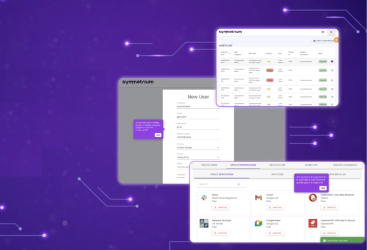
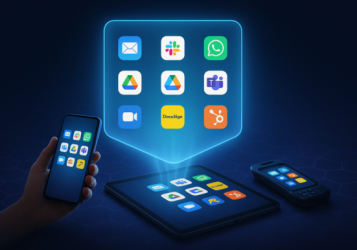
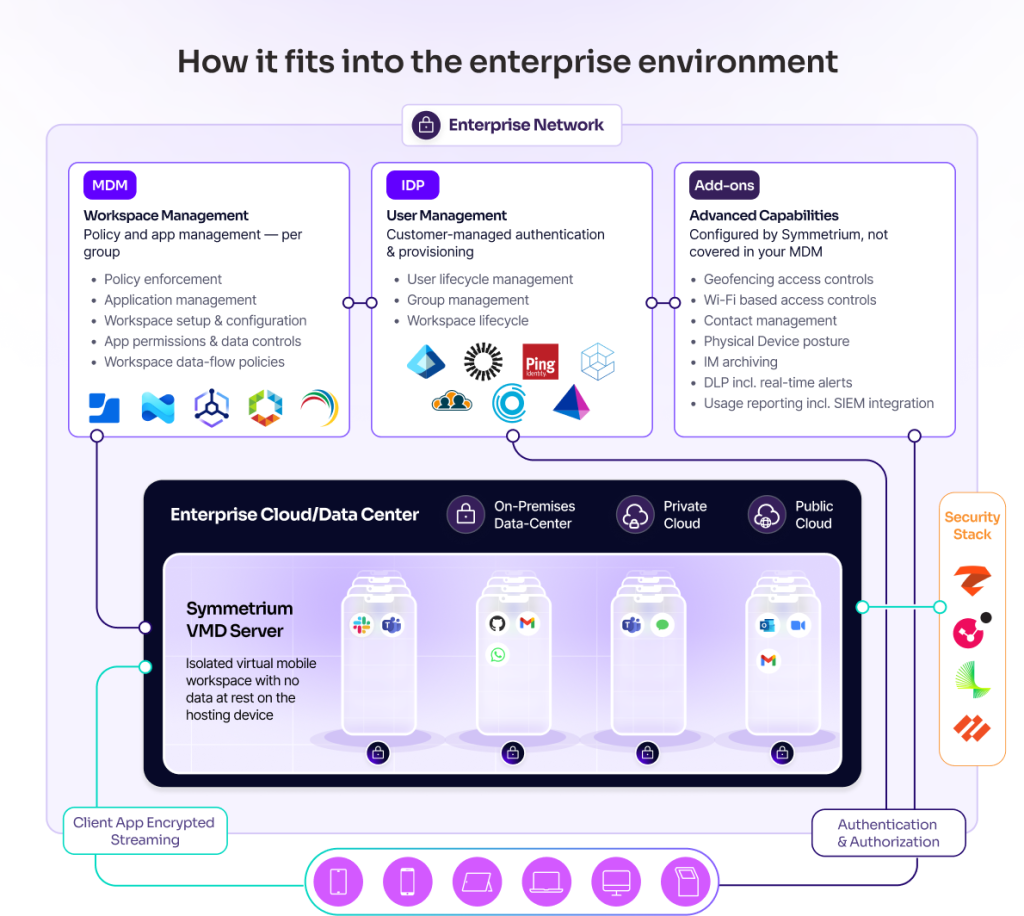
Go runs inside the customer’s existing UEM. Whatever they have: Microsoft Intune, VMware Workspace ONE, Ivanti, anything, Go fits into it. There is no new management console. There is no parallel admin plane. There is no integration project. The customer’s security and mobility team uses the tools they already operate.
This is the part of the architecture that took us the longest to get right, and it’s why we’re launching Go as a distinct offering rather than as a deployment mode of the platform.
What “no replacement” actually means
Most BYOD products say they “integrate with your stack.” Then the customer’s IT team runs the proof of concept and discovers what integration actually requires: new identity flows, new policy mappings, new admin training, new agents, new exception handling. The replacement happens quietly, in the seams.
Symmetrium Go doesn’t do that.
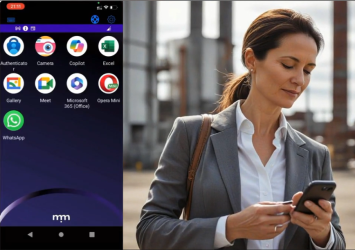
The workspace runs on Symmetrium’s infrastructure. The customer’s UEM keeps doing what it does: managing the devices it was already managing, applying the policies it was already applying. Go simply provides a workspace that streams to the device, sitting underneath those existing controls rather than above them.
The customer’s admin team doesn’t learn a new product. They get a new capability inside the product they already run.
That’s a precise architectural commitment, and it’s why deployments that would otherwise take months take hours.
A real deployment, in three hours
A European utility customer with thousands of employees, deployed Symmetrium Go inside their existing Microsoft Intune environment in three hours. Their team did the work. We watched.
Three hours included: connecting Go to the customer’s identity provider, configuring policy mapping inside their Intune environment, and provisioning the first batch of users. By the end of the morning, employees were using the workspace.
This is the kind of deployment our partners (mobile operators, MSPs, system integrators, security practices) need in order to actually scale enterprise BYOD programs. Not a six-month services engagement. Not a custom integration. A turnkey deployment inside the customer’s existing environment.
We didn’t get there by simplifying the product. We got there by being uncompromising about the architecture: the customer’s stack is the customer’s stack, and Go has to work inside it without conditions.
Why this matters for scale
Partners selling enterprise mobility have a recurring problem. Each deployment requires a custom services engagement because each customer environment is different. Margin compresses as integration cost rises. Time-to-revenue stretches. Programs that should reach thousands of employees stall at hundreds because the deployment model doesn’t scale.
Go solves the scale problem at the architectural level. The same deployment shape works across customer environments because Go inherits the customer’s existing stack rather than imposing its own. A partner can run twenty deployments concurrently because each one is fast, repeatable, and doesn’t require a custom integration.
That’s the unlock. The product isn’t different from what we’ve offered before — the scalability of the deployment is.
What’s still in the full platform
Symmetrium Platform is still there. For customers and partners who need a dedicated workspace management console, multi-tenant operator-grade governance, advanced policy tooling, deep operational visibility, and the full set of compliance capabilities, the platform is the right answer. Many of our largest customers are on it. Many of our most demanding regulated deployments require it.
Go is the entry point. It does what most partners need most of the time: deploy a workspace at scale, inside an environment that’s already in place, without an integration project.
Some customers will start with Go and stay there. Some will start with Go and move to the full platform as their program matures. Some will choose the platform from the beginning because their environment requires it. All three paths are valid; the choice is about deployment shape and governance depth, not about product quality.
What we’re asking partners to do
If you’re a partner reading this, mobile operator, MSP, system integrator, security practice, Go is the SKU we built for you.
It’s deployable. It’s repeatable. It generates recurring revenue per workspace, with an attached enterprise work line, billed through your platform. The commercial model is operator-friendly by design. The deployment model is partner-friendly by design.
The fastest way to evaluate it is to deploy a small pilot inside a real customer environment. We can have one running in days. The pilot will tell you more about the deployment fit than any pitch can.
If you’re a partner who’s been waiting for BYOD to be deployable at the speed your enterprise customers actually need, Go is what we built for that.
📧 partnerships@symmetrium.io
— Omer