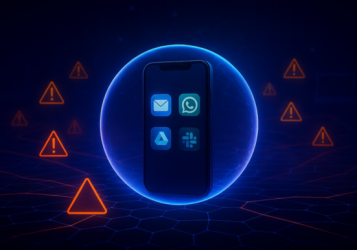
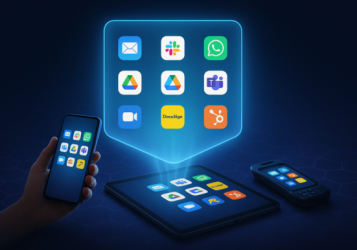
Government field teams depend on fast, discreet mobile communication. Yet the tools they rely on—personal messaging apps, unmanaged devices, and ad-hoc workphones—create unavoidable risk.
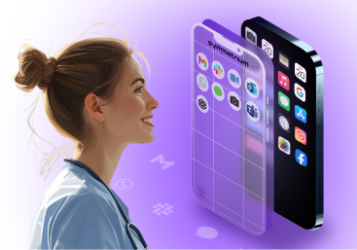
To explore a new operational model, a confidential government intelligence agency conducted a controlled pilot with Symmetrium. Their goal: evaluate whether a virtual mobile workspace—fully isolated, zero data at rest, and streamed to any personal phone—could support the realities of high-sensitivity field communication.
What follows is a summary of what was tested and what was learned.
The Operational Challenge: Secure Comms Without Compromising the Operator
For field personnel, mobile communication must feel natural, immediate, and trustworthy. But the operational environment introduces constraints:
- Personal phones are often the only practical device in field or off-site scenarios.
- MDM and surveillance agents are unacceptable—both operationally and from a privacy standpoint.
- Apps like WhatsApp are indispensable, yet ungoverned messaging creates compliance, exposure, and data-leak risks.
- A clean, separate work identity is needed—without touching or monitoring the personal environment.
The agency sought a model where operatives could use secure, policy-controlled communication without giving up their privacy or compromising their operational safety.
Why Symmetrium: A Separate, Secure Identity for Field Operations
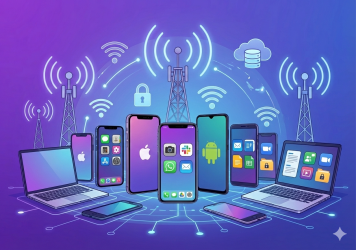
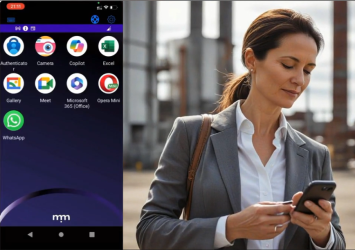
Symmetrium provides a fully isolated work environment streamed from the organization’s infrastructure, with zero data ever stored on the physical device. For high-sensitivity field use, this architecture aligns naturally with operational constraints:
- No enrollment, no agents, no access to personal data
- A separate operational identity with full policy enforcement
- Ability to run apps like WhatsApp, Telegram, Facebook and Instagram inside the workspace with compliance logging
- Native performance that matches how operatives already communicate
This combination—security, compliance, and natural UX—made it a strong candidate for evaluation.
Inside the Pilot: Testing a Controlled Intelligence Workspace
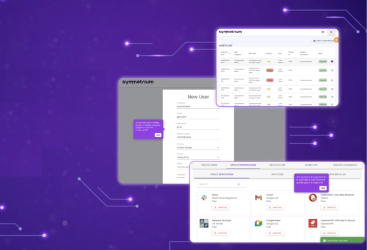
During the pilot, the agency deployed 10 virtual mobile devices, each providing a secure workspace accessible from a personal phone. The environment included:
- A dedicated operational WhatsApp number for each workspace
- Secure messaging with organization-level visibility
- An isolated workspace streamed from the agency’s server
- Policy-controlled usage, including DLP features and access enforcement
All configurations aligned with the agency’s internal communication requirements.
How Operatives Used the System: Real-World Behavior at Real Volume
Over the course of the two-month pilot, operatives used the workspace heavily and consistently:
- 4,435 messages exchanged
- 986 chat sessions
- 2,086 system connections
- 210 average daily usage
- 68 distinct conversation threads
Usage patterns mirrored everyday mobile behavior—fast exchanges, frequent reconnections, and natural communication flow. According to the pilot’s UX observations, participants reported a familiar, frictionless experience, similar to using their regular device. Support needs were minimal, and all issues were resolved quickly.
Validated Operational Capabilities: Privacy, Control, and Operator Effectiveness
Based on the pilot results, the agency validated several key operational advantages:
- Sensitive data never touches the physical device—reducing risk during stops, searches, and inspections.
- The operational identity remains fully separate and centrally controlled.
- Messaging can be audited and governed without monitoring the personal phone.
- Policy controls (screenshot, screen recording, copying, exporting) function reliably.
- Operators retain full, native control over their day-to-day communication—adding contacts naturally and requesting new apps as operational needs evolve.
- Approved tools and updates can be deployed across all workspaces within seconds, eliminating the back-office delays that typically slow down secure communication changes.
- Teams can communicate and adapt quickly, without training or workflow disruption.
The pilot demonstrated that government field teams can operate securely on personal devices while maintaining both centralized governance and real-time operational flexibility.
Strategic Impact: A New Model for Government Field Mobility
The successful test of a single operational identity lays the foundation for broader applications across government field operations:
• Single-Identity Workflows: Secure Communications for Field Personnel
Validated during the pilot—ideal for teams operating across locations and departments.
• High-Sensitivity Operations: Separation That Protects the Operator
A secure work identity with zero data at rest and fully revocable access.
• Multi-Identity Operations: The Next Step Forward
While not part of the pilot, Symmetrium’s architecture supports evolving toward multiple isolated profiles and policy sets—important for agencies with complex operational roles.
What’s Next: Scaling Secure Mobility for Government Field Agencies
The agency is now analyzing expansion paths for additional field-focused operational groups. The pilot confirmed that a virtual mobile workspace can offer operations-grade security without compromising how personnel communicate or how field work is carried out.
Symmetrium continues to work with government field agencies to refine this model and support the next generation of secure mobile communication for high-sensitivity operational environments.
Symmetrium gives sensitive teams a secure mobile identity they can trust.
If you’re building capabilities for field, operational, or high-sensitivity teams, we’re here to help you evaluate whether this model is the right fit for your environment.
Reach out >>