Recently, the world came dangerously close to learning U.S. military strike plans in Yemen before the operation took place. Not because of espionage. Not because of a cyber breach. Because of a Signal group chat.
A senior White House official created an unauthorized thread using the encrypted messaging app Signal. Inside that chat, officials discussed confidential details of an upcoming operation. Then, a journalist was added to the group.
This wasn’t an encryption failure. It was a system with no guardrails. Sensitive conversations happened off the record, on personal phones, through apps outside the organization’s control. The only reason those plans didn’t go public is because one journalist chose not to publish.
It was not a hack. It was a human decision. And it could have gone very differently.
The Anatomy of the Breach
The incident, now known as Signalgate, centered around a group chat created by former Fox News host and senior Trump advisor Pete Hegseth. Using Signal, he brought together current and former White House officials to discuss sensitive national security topics, including active military planning in Yemen.
This chat was not authorized. It operated outside official channels, on personal devices, without oversight or approval. Somewhere in the conversation, a journalist was added to the group. The messages kept flowing.
The journalist eventually stepped forward and exposed the existence of the chat. But they did not publish the operational details that had been shared inside it. That restraint is the only reason the situation didn’t escalate into a full-scale national security failure.
There was no hack. No hostile actor broke through Signal’s encryption. This was an internal failure of judgment, process, and control. It happened in plain sight.
This Is What No Control Looks Like
Signal didn’t fail. Encryption held. What broke down was the ability to control how sensitive information gets shared in the first place.
The group chat happened because nothing stopped it from happening. There were no systems in place to prevent officials from using personal phones or unauthorized apps. No monitoring. No visibility. No restrictions on who could be added. The journalist wasn’t slipped in through a backdoor. They were invited because nothing in the setup said they couldn’t be.
And this isn’t just a White House problem. It’s a pattern across every organization that allows sensitive work to spill over into personal devices and private channels. When guardrails don’t exist, users fall back on what’s fast, familiar, and convenient. Even if that means discussing classified operations in a consumer app with no oversight.
The breach wasn’t an anomaly. It was the natural outcome of letting policy become optional and letting enforcement disappear.
BYOD Isn’t the Enemy, Uncontrolled BYOD Is
What happened in that Signal chat wasn’t some rare edge case. It was the natural outcome of a world where personal phones double as work devices, and where people use whatever tools feel most convenient in the moment.
Bring Your Own Device policies are everywhere. They’re efficient, scalable, and in most cases, impossible to avoid. But without control, BYOD becomes a direct pipeline to risk. Employees install consumer apps. They spin up unofficial channels. They forward sensitive content into places no one can see or stop.
It’s not just that the system failed to block the Signal chat. The system didn’t exist. There was no secure workspace to default to. No boundaries between personal and professional activity. No way to enforce who could be part of the conversation or what could be shared.
The issue isn’t that people use their own phones. It’s that organizations haven’t done enough to contain what those phones can do.
The Alternative: Control Built In
Symmetrium doesn’t try to block every risky app or rely on users to follow policy. It removes the need for that kind of trust in the first place.
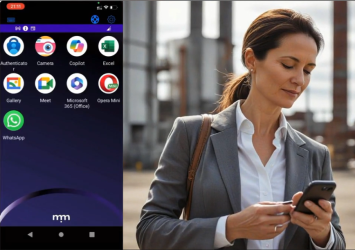
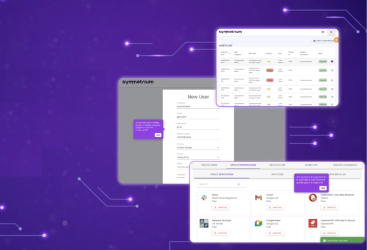
Sensitive work takes place inside a virtual mobile workspace. This workspace is isolated from the rest of the device, with pre-approved apps and fully controlled access. Everything inside it is governed by IT: who can use it, what they can do, and who they can contact.
No data is stored on the device. Not messages, not documents, not even temporary files. If the phone is lost, stolen, or compromised, there is nothing available to extract. If someone tries to bring in an outsider, the system prevents it. If they attempt to move the conversation elsewhere, there are no unofficial tools to fall back on.
Symmetrium creates an environment where the kind of misuse that led to the Signal breach simply isn’t possible under normal conditions.
Integrity Is Not a Security Strategy
The only reason the world didn’t see U.S. military plans in the headlines was because one person chose not to leak them. That choice wasn’t driven by policy. It wasn’t blocked by technology. It was a moment of personal restraint.
That isn’t how security should work.
You can’t build a strategy around people always doing the right thing. Even well-meaning employees make mistakes. Some take shortcuts. A few act with intent. None of that can be predicted, and none of it should be the last line of defense.
What happened in that Signal group chat wasn’t caught by a system. It was stopped by luck and conscience. The next incident might not be.
Lock It Down Before It Goes Public
By the time a journalist is sitting in a group chat about military operations, it’s already too late. This wasn’t a failure of technology. It was the absence of control.
Symmetrium gives teams the structure they need to keep sensitive work where it belongs. No off-channel apps. No invisible conversations. No reliance on people to get it right every time.
If your data can walk out the door with someone’s phone, the door is already open.
Let’s close it. Get in touch to see how Symmetrium works.