Healthcare organizations face an escalating threat from cyberattacks, putting sensitive patient data and patient lives at risk. The rapid digitization of healthcare has significantly broadened the attack surface, leading to a surge in ransomware attacks and data breaches. In 2023 alone, the U.S. reported over 725 healthcare data breaches, exposing more than 133 million patient records. Attackers exploit the critical nature of healthcare services, recognizing hospitals will often pay ransoms to swiftly restore essential operations.
The devastating WannaCry ransomware attack of 2017 starkly illustrates the consequences of weak cybersecurity. Within days, WannaCry infected medical devices in hospitals worldwide, severely disrupting critical patient care services. In the UK alone, over 80 NHS hospitals suffered operational shutdowns, underscoring the extreme vulnerability posed by outdated and unpatched medical systems. With damages exceeding $100 million globally, WannaCry became a turning point, highlighting the urgent need for better cyber hygiene and the enforcement of strict security standards in healthcare.
Mobile devices represent a particularly vulnerable entry point. Ubiquitous in healthcare for telemedicine, patient communications, and data access, smartphones and tablets introduce significant risks from unsecured Wi-Fi, device theft, phishing attacks, and poor device management practices. A recent industry analysis revealed that nearly 70% of healthcare data breaches were due to the loss or theft of mobile devices or files. As healthcare continues its digital expansion, effective mobile security has become as essential as traditional network protections.
The SingHealth data breach of 2018 provides a clear example of why regulatory frameworks are becoming increasingly strict. Attackers breached Singapore’s largest healthcare provider, accessing 1.5 million patient records, including sensitive government data. Fundamental security gaps—such as the lack of enforced multi-factor authentication, inadequate employee training, and weak incident response protocols—allowed attackers to operate unnoticed for months. The severity of the breach prompted Singapore to implement stringent new cybersecurity regulations, reflecting global trends toward tighter controls, such as the GDPR, HIPAA, and the new NIS2 directive.
This guide explores critical lessons from these incidents and outlines practical measures healthcare organizations can implement to safeguard against emerging mobile cyber threats.
The guide is structured as follows:
- Mobile-Specific Attack Vectors: Analysis of common mobile vulnerabilities illustrated through real-world incidents.
- Global Regulatory Changes: Overview of the evolving regulatory landscape and its impact on healthcare security requirements.
- Critical Security Measures: Discussion of essential measures such as multifactor authentication, zero-trust policies, and privilege access management.
- Symmetrium’s Approach: How Symmetrium specifically addresses mobile security challenges highlighted in this guide.
- Conclusion: Key takeaways and recommended next steps for healthcare leaders.
By understanding the threat landscape and proactively strengthening mobile security defenses, healthcare organizations can protect their operations, secure sensitive patient data, and maintain critical care services.
Mobile Threat Vectors: Understanding the Risks and Real-World Consequences
Mobile devices have become indispensable in modern healthcare—but they also introduce unique and dangerous vulnerabilities. This section analyzes the most common mobile-related attack vectors, from insecure devices and applications to compromised communication channels, and illustrates their real-world impact through a series of high-profile case studies.
Technical Analysis of Mobile Attack Vectors
Vulnerabilities in Mobile Devices
Mobile devices inherently pose significant risks due to portability and susceptibility to loss or theft, which can easily expose sensitive healthcare data. Personal devices used under BYOD policies often run outdated operating systems or applications, increasing exposure to known vulnerabilities. Unlike corporate-managed devices, personal smartphones and tablets frequently lack critical security controls, including strong encryption and enforced multi-factor authentication, making them attractive targets for cybercriminals. Managing diverse personal devices adds complexity, amplifying the difficulty of securing healthcare environments.
Vulnerabilities in Mobile Applications
Healthcare mobile applications themselves frequently contain critical security weaknesses. Common issues include insecure data storage practices, inadequate server-side protections, insecure communication protocols, improper user authentication, and weak cryptography. Other prevalent vulnerabilities include client-side injection, insecure session handling, and inadequate binary protection, which allow attackers to reverse-engineer apps. Additionally, healthcare apps often contain embedded, hard-coded API keys or user credentials, dramatically increasing the risk of unauthorized access to patient information.
Vulnerabilities in Communication Protocols
Mobile communication in healthcare environments faces multiple security challenges. Employees frequently connect to unsecured Wi-Fi networks, making sensitive patient data vulnerable to interception. Standard SMS or free messaging apps used to communicate protected health information (PHI) often do not comply with HIPAA or similar regulatory standards due to inadequate security measures. Mobile devices are also increasingly targeted through phishing and SMS phishing (“smishing”) attacks, exploiting the simplified interfaces and reduced visibility of security indicators, making it easier for attackers to bypass defenses like multi-factor authentication (MFA).
Real-World Case Studies of Mobile-Related Breaches
Theft of Unencrypted Devices
Mobile device theft remains a persistent risk in healthcare, especially when devices are not properly secured. In October 2024, Roswell Park Comprehensive Cancer Center reported that an employee’s mobile phone was stolen, and the device had access to a hospital email account via the Microsoft Outlook app. While no evidence confirmed that patient data was viewed or extracted, the account did contain sensitive information, including names, medical record numbers, dates of birth, treatment details, and encounter numbers for over 11,000 patients. This incident highlights the critical need for enforced device-level security, strict access controls, and user training, particularly when mobile devices are used to access protected health information (PHI).
Compromised Credentials via Mobile Devices
Mobile devices frequently serve as entry points for credential compromise. The 2015 Medical Informatics Engineering breach, involving stolen credentials affecting millions, likely originated from phishing attacks targeting employee mobile devices. Similarly, the L’Assurance Maladie breach in 2022 saw attackers leveraging compromised credentials potentially acquired via mobile devices. These examples highlight how mobile vulnerabilities can escalate into broad systemic breaches.
Mobile Apps and Data Exposure
Vulnerabilities within healthcare mobile apps have directly caused significant data breaches. For example, in 2022, Regal Medical Group’s mobile apps exposed PHI to third parties due to improperly configured tracking pixels. Advocate Aurora Health faced a similar incident where patient portals using Meta Pixel inadvertently shared millions of patient records with Facebook. These incidents underscore the critical need for strict application security and privacy controls.
BYOD and Insufficient Security Controls
Personal devices used under BYOD policies have facilitated major breaches. In 2020, the ransomware attack on the University of Vermont Health Network originated from malware introduced when an employee accessed personal email on a work device lacking sufficient security controls. This highlights how blurred boundaries between personal and professional device use can drastically amplify risks in healthcare settings.
Table 1: Case Studies of Mobile Endpoint Attacks in Healthcare
| Case Study | Year | Attack Vector | Impact |
| Roswell Park Comprehensive Cancer Center | 2024 | Mobile Device Theft (Email Access via Unsecured App) | Potential exposure of PHI for 11,435 patients, triggered policy overhaul |
| Regal Medical Group | 2022 | Mobile App Vulnerability (Tracking Pixels) | Exposure of PHI to third parties, HIPAA violation |
| Advocate Aurora Health | 2022 | Mobile App Vulnerability (Website Tracking Device) | Exposure of data of 3 million patients |
| UVM Health Network | 2020 | BYOD (Personal Email on Work Laptop) | Ransomware attack, significant operational disruption |
| Medical Informatics Engineering | 2015 | Compromised Credentials (Likely via Phishing) | Breach of 3.9 million patient records |
The Global Regulatory Climate: Frameworks and Compliance
Global regulators have established stringent laws mandating robust cybersecurity practices for healthcare organizations, reflecting the critical need to protect patient data and ensure operational continuity.
United States: HIPAA
In the United States, the Health Insurance Portability and Accountability Act (HIPAA) sets the baseline. The HIPAA Security Rule “requires appropriate administrative, physical and technical safeguards to ensure the confidentiality, integrity, and security of electronic protected health information.” Healthcare providers and their business associates must implement measures like access controls, audit logs, data encryption, and device security policies to prevent breaches of patient information. Failure to do so can result in heavy penalties – U.S. regulators have issued multi-million dollar fines for breaches caused by insufficient access controls or risk management. For instance, in 2023 a U.S. health system paid $5.5 million to settle HIPAA violations after a cyber incident tied to poor oversight of privileged access (no regular access reviews or log audits). In short, U.S. law makes clear that healthcare organizations are expected to proactively secure patient data, including data on mobile devices, or face legal and financial consequences.
European Union: GDPR and NIS2
In Europe, data protection and cybersecurity laws are particularly stringent. The EU General Data Protection Regulation (GDPR) classifies health data as sensitive “special category” information, requiring organizations to apply extra safeguards and obtain patient consent for its use. GDPR’s “privacy by design” principle means security controls must be baked into any system handling personal health data, and breaches must be reported within 72 hours. Fines for non-compliance can reach up to 4% of global annual turnover, incentivizing strong security practices. In addition, Europe’s newly adopted NIS2 Directive directly targets cybersecurity in critical sectors like healthcare. NIS2 “establishes a unified legal framework to uphold cybersecurity in 18 critical sectors across the EU”, including healthcare providers. It mandates that hospitals and clinics implement comprehensive cyber risk management measures and incident reporting. Concretely, “NIS2 requires healthcare organizations to protect patient data from cyber threats by implementing cyber risk management measures, having a clear incident-reporting process, and securing patient data through proper storage and handling practices.”. Healthcare entities must also ensure continuity of care by minimizing the risk of outages from cyberattacks, reflecting regulators’ recognition that a cyber incident can threaten lives, not just data. GDPR and NIS2 thus work in tandem – one focusing on data privacy and breach response, and the other on overall network and system resilience – to raise the bar for healthcare cybersecurity in Europe. Compliance is challenging, as noted by EU guidance, since NIS2 “adds an additional layer of cybersecurity regulations that healthcare organizations must comply with” on top of HIPAA or GDPR. Nonetheless, these frameworks are spurring healthcare providers to strengthen identity controls, encryption, incident response, and supply chain security, with a particular eye on newer risk areas like cloud services and connected devices.
MENA and APAC: Evolving Regulatory Trends
Across the MENA and APAC regions, regulatory trends are converging toward those in the U.S. and EU, although implementation varies by country. The influence of the GDPR is evident – as one analysis notes, the EU’s regulation “has shaped the regulatory landscape far beyond the European Union”, with many jurisdictions in Asia-Pacific and the Middle East emulating its strict protections. For example, Saudi Arabia enacted a Personal Data Protection Law in 2023 and the UAE’s Federal Data Protection Law (2021) now governs personal data handling, including health information, in those nations. These laws often mirror GDPR principles like consent, data minimization, and breach notification, and are supplemented by sector-specific rules.
The UAE law, for instance, is “supplemented by a set of consumer protection standards that apply exclusively to the finance and healthcare industries.” This indicates extra requirements for safeguarding health data. Meanwhile, governments in the Middle East have also published national cybersecurity standards for critical infrastructure: for instance, Qatar’s National Cyber Security Agency issued frameworks in 2021, and Saudi Arabia’s NCA has Essential Cybersecurity Controls that likely apply to healthcare providers. In the Asia-Pacific Region, several countries label healthcare as critical infrastructure in their cyber laws. Singapore’s Cybersecurity Act mandates that healthcare institutions (as designated Critical Information Infrastructure) adhere to government codes of practice and report incidents promptly, following the lessons of its 2018 SingHealth breach. Australia and Japan enforce breach notification and health data privacy under their respective laws (Australia’s Notifiable Data Breaches scheme, Japan’s APPI), and are updating regulations to address medical device security and telehealth. Overall, while MENA and APAC regulatory frameworks are still evolving, there is a clear increased commitment to protection of the personal information of patients in these regions. Healthcare organizations in MENA/APAC are thus increasingly expected to implement strong mobile device security, encryption, and identity management in line with global best practices – even in countries where explicit health cybersecurity laws are nascent. In summary, whether by legal requirement or prudent risk management, compliance pressures worldwide now demand robust safeguards for healthcare data, especially as it flows through mobile and connected technologies.
Table 2: Summary of Key Healthcare Cybersecurity Regulations by Region
| Region | Key Regulations | Key Requirements Related to Mobile Security |
| US | HIPAA, HITECH Act, FDA Guidelines | Protection of ePHI, implementation of safeguards, breach notification, cybersecurity for medical devices |
| Europe | GDPR, NIS2 Directive, EU Action Plan | Data protection principles, enhanced cybersecurity measures for critical sectors, incident reporting |
| MENA | UAE Data Protection Law, Saudi PDPL, Qatar PDPPL | Safeguarding personal data, strict access controls, specific requirements for health data processing |
| APAC | Various national data protection laws (e.g., Australia Privacy Act, India Digital Information Security in Healthcare Act) | Often resemble GDPR, focus on data security, consent, and breach notification |
Globally, healthcare organizations face growing pressure, both legal and reputational, to implement robust cybersecurity frameworks, especially securing patient data across increasingly mobile and interconnected environments.
Critical Security Measures: MFA, Zero Trust, and PAM
Analysis of healthcare data breaches consistently reveals three critical weaknesses: weak authentication, implicit network trust, and poorly controlled privileged access. To mitigate these vulnerabilities, healthcare organizations are encouraged to implement three cornerstone measures: Multi-Factor Authentication (MFA), Zero Trust policies, and Privileged Access Management (PAM).
Multi-Factor Authentication (MFA)
MFA requires users to present multiple verification factors, such as a password combined with a one-time code or biometric, to access sensitive data. It directly addresses the risk posed by stolen or weak credentials, a common entry point in breaches. The SingHealth incident vividly illustrates MFA’s necessity: attackers breached critical administrator accounts because two-factor authentication was not fully enforced, allowing unauthorized access with stolen passwords alone. Robust MFA could have significantly mitigated or even prevented this breach.
In healthcare, implementing MFA for remote access, Electronic Health Records (EHR), and particularly for high-level accounts (administrators, physicians, executives) is now widely considered a baseline security requirement. Regulations such as the HIPAA Security Rule implicitly mandate robust authentication methods, recognizing MFA as a key control. MFA’s effectiveness extends specifically to mobile healthcare scenarios; apps accessing patient data must always prompt for an additional authentication factor or use device biometrics, safeguarding against risks from lost or stolen devices.
Zero Trust Policies
Zero Trust security fundamentally changes traditional security models by adopting a “never trust, always verify” approach. Instead of assuming devices or users within a network perimeter are safe, Zero Trust continuously authenticates and authorizes every access request, significantly limiting lateral movement within networks. Implementing this in healthcare means adopting measures such as network micro-segmentation—separating clinical devices, administrative systems, and payment gateways—and enforcing dynamic access controls.
Had Zero Trust been fully implemented during the WannaCry ransomware attack, the malware’s ability to spread unchecked across hospital systems would have been significantly curtailed, as every network connection would be continuously assessed. Similarly, Zero Trust would have identified and potentially blocked unusual database queries during the SingHealth breach. Technologies supporting Zero Trust—such as software-defined perimeters, identity-aware proxies, and real-time device compliance checks—are essential to protect modern healthcare environments, particularly given the high prevalence of legacy systems with inherent security gaps.
Privileged Access Management (PAM)
Privileged accounts, including system administrators, database administrators, and service accounts, represent a significant risk if compromised. PAM solutions directly address this risk by ensuring strict control over these high-level accounts. Best practices include individual account accountability, ephemeral credentials (temporary, one-time-use passwords), logging and continuous monitoring of all privileged sessions, and implementing just-in-time privilege elevation to minimize exposure.
The critical importance of PAM in healthcare security has been underscored repeatedly in major breaches. The U.S. Department of Health and Human Services has explicitly warned that strong PAM practices can prevent significant financial and reputational damage. In the SingHealth case, attackers essentially gained administrative privileges, enabling them unrestricted access to patient data, precisely what PAM is designed to prevent. With proper PAM controls, unusual administrative activity would trigger immediate alerts or session termination, dramatically reducing attackers’ ability to move freely and escalate privileges.
In the mobile and cloud context, PAM extends to ensuring any privileged session—whether initiated from a workstation or mobile device—requires authentication through secure PAM gateways, eliminating direct root access with static credentials. By significantly limiting the window of opportunity for privilege abuse, PAM substantially reduces the potential impact of breaches.
Together, MFA, Zero Trust, and PAM constitute a powerful, complementary framework for addressing the most common and damaging vulnerabilities observed in healthcare cybersecurity breaches. Implemented cohesively, these measures significantly enhance protections around user access, network security, and administrative privileges, establishing essential defenses to safeguard patient data and healthcare operations.
Implementing Best Practices for Enhanced Mobile Security and Compliance
To effectively counter mobile-related threats, healthcare organizations must go beyond basic safeguards and adopt strategic, policy-driven security frameworks. This section outlines practical, high-impact actions organizations can take to strengthen their mobile security posture while aligning with global compliance requirements.
Practical Strategies for Adoption
Adopt Zero Trust Framework: Implement comprehensive authentication and least-privilege controls for all mobile access. Zero Trust requires continuous verification of users and devices, ensuring every access attempt aligns with stringent policies. Solutions like Symmetrium, built explicitly with Zero Trust architecture, simplify the adoption of this framework for mobile endpoints.
“No Data at Rest” Strategy: Healthcare organizations should eliminate local storage of sensitive data on mobile devices by employing secure streaming technologies. Symmetrium’s VMD approach ensures data remains securely within organizational boundaries, significantly reducing breach risks associated with endpoint compromises.
Robust Mobile Device Policies: Develop clear and enforceable policies covering BYOD scenarios, mandating strong passwords, biometric authentication, screen locks, encryption, and prohibiting unauthorized app usage. Regular policy updates are essential to address evolving threats.
Staff Training and Awareness Regularly educate healthcare personnel on mobile security policies and threat recognition,especially phishing and smishing. Training must clearly communicate the risks associated with BYOD and personal device usage.
How Symmetrium Helps: Technical Breakdown of Symmetrium’s Security Offerings
Implementing advanced mobile security practices can be challenging, especially when enforcement depends on individual behavior, device diversity, or fragmented tools. Symmetrium eliminates these blind spots by shifting mobile security enforcement from the user to the infrastructure. Its platform wraps critical best practices like Zero Trust, MFA, and PAM into a single, centralized solution, ensuring consistent protection without relying on end-user compliance.
Virtual Mobile Device (VMD) Architecture
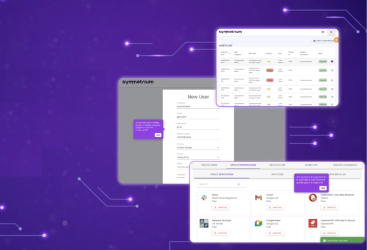
Symmetrium integrates critical security principles—MFA, Zero Trust, and Privileged Access Management—into its innovative Virtual Mobile Device (VMD) platform, designed specifically to secure mobile usage in healthcare. Each user’s mobile device acts solely as a thin client, streaming an interactive interface from a securely hosted virtual workspace within the organization’s data center or cloud environment. No patient or sensitive data ever resides on the physical mobile device, effectively eliminating risks related to device loss, theft, or endpoint malware.
Multi-Factor Authentication (MFA) Enforcement
Symmetrium mandates robust MFA, supporting biometric authentication (e.g., Face ID, fingerprint) and integrating seamlessly with enterprise directories like Active Directory. When clinicians or administrators attempt access, they must verify their identity through multiple authentication factors. This strict authentication directly mitigates credential theft risks, as seen in high-profile breaches such as SingHealth.
Zero Trust Principles
Operating fully within a Zero Trust Architecture (ZTA), Symmetrium continuously authenticates and monitors every session. Any abnormal behavior—such as sudden changes in network status or device posture—triggers immediate session termination or quarantine. Granular, group-based policies restrict user actions within the virtual environment, applying least-privilege principles and network micro-segmentation. For instance, hospital staff can be restricted from transferring patient data outside approved applications or beyond defined geographic perimeters (geo-fencing).
Privileged Access Management (PAM) & Auditability
All activities within the VMD sessions are centrally logged and monitored, creating a detailed audit trail essential for compliance and incident investigation. This comprehensive visibility ensures even privileged administrative sessions occur transparently, eliminating anonymous access risks. Secure instant messaging and enforced compliance controls (e.g., archiving of PHI messages) further prevent unauthorized shadow IT usage.
Reduced Risk Surface by Design
Symmetrium’s design significantly reduces the mobile threat surface. By isolating all sensitive data and applications within secure server environments—consistently patched, monitored, and protected—the risk from vulnerabilities on endpoint devices is dramatically reduced. Even if endpoint malware compromises a user’s physical device, attackers cannot access or exfiltrate sensitive data, as it never resides on endpoints (“no data at rest means no data at risk”).
Aligning Symmetrium with Regulatory Compliance
Compliance in healthcare isn’t optional. It’s a legal and operational imperative. Symmetrium is built to help healthcare organizations meet the world’s most demanding data protection and cybersecurity regulations. By embedding technical safeguards directly into the infrastructure, Symmetrium simplifies compliance across regions and use cases, whether it’s HIPAA in the U.S., GDPR and NIS2 in Europe, or emerging data protection frameworks in MENA and APAC.
United States (HIPAA)
Symmetrium’s architecture inherently aligns with HIPAA Security Rule requirements through robust authentication, stringent access control measures, comprehensive audit logging, and secure handling of electronic Protected Health Information (ePHI).
European Union (GDPR)
Symmetrium supports GDPR compliance by applying data minimization (no data at rest), end-to-end encryption, and strict access control. Its approach satisfies GDPR’s principles of privacy by design, data protection by default, and timely breach notification.
MENA & APAC Data Protection Laws
Symmetrium’s robust security—zero trust, encryption, and detailed auditing—facilitates compliance with emerging data protection laws across the MENA and APAC regions, including UAE’s Data Protection Law and Saudi Arabia’s PDPL, both of which mandate strict access controls and data protection measures.
Medical Device Security Regulations
Symmetrium provides an additional security layer for mobile interfaces to medical devices. By using secure, segmented virtual environments that isolate medical-device interactions, the platform aligns with regulatory guidelines from the FDA and similar global agencies, reducing risks of unauthorized access or manipulation.
Table 3: Comparative Analysis of Mobile Security Countermeasures
| Countermeasure | Key Features | Advantages | Disadvantages | Relevance to Healthcare Mobile Security |
| MDM (Mobile Device Management) | Device enrollment, policy enforcement, remote wipe | Centralized management, security policy enforcement | Can be intrusive on personal devices, data may still reside on the device | Provides some security but doesn’t fully address “no data at rest” |
| MTD (Mobile Threat Defense) | On-device threat detection and prevention | Protects against malware, phishing, network attacks | Doesn’t prevent data storage on the device, effectiveness depends on updates | Valuable for endpoint protection but doesn’t eliminate data breach risk from device loss |
| Symmetrium | Virtual Mobile Device, no data at rest, zero trust architecture | Non-invasive, eliminates data on device risk, centralized management, robust security framework | Requires infrastructure for VMD hosting | Highly relevant, addresses key vulnerabilities and regulatory requirements in healthcare |
By integrating best practices into its secure VMD architecture, Symmetrium directly addresses key vulnerabilities revealed by major healthcare breaches. Its comprehensive mobile security capabilities—rooted in MFA, Zero Trust, and PAM—enable healthcare providers to effectively protect sensitive data, ensure regulatory compliance, and confidently embrace mobile innovation without compromising security.
Strengthening Healthcare Cybersecurity: A Roadmap for Mobile Protection
As healthcare continues its rapid digital transformation, the need for robust cybersecurity strategies to protect patient data, maintain compliance, and safeguard critical operations has never been greater. The evolving threat landscape—marked by increasingly sophisticated ransomware, credential theft, mobile vulnerabilities, and regulatory scrutiny—requires healthcare organizations to proactively embrace advanced security frameworks and best practices.
This guide underscores the critical role that Multi-Factor Authentication (MFA), Zero Trust, and Privileged Access Management (PAM) play in addressing vulnerabilities repeatedly exploited by attackers. These measures, when properly implemented, significantly reduce risks associated with compromised credentials, lateral network movement, and unauthorized privileged access—core elements observed in high-profile breaches like WannaCry and SingHealth.
Symmetrium uniquely bridges the gap between stringent cybersecurity demands and practical mobile usage. By leveraging its innovative Virtual Mobile Device (VMD) architecture, enforcing a “no data at rest” policy, and embedding zero trust principles directly into its solution, Symmetrium effectively neutralizes the primary risks associated with mobile devices. Healthcare organizations using Symmetrium not only achieve stronger security but also meet rigorous regulatory requirements globally—be it HIPAA in the U.S., GDPR and NIS2 in Europe, or emerging standards in MENA and APAC.
Moving forward, healthcare leaders must prioritize mobile security, recognizing it as an integral component of their overall cybersecurity strategy. By aligning technology investments, policies, and user training with solutions like Symmetrium, organizations can confidently navigate the evolving threat landscape, ensure compliance, and continue to provide uninterrupted, secure patient care. To find out more, book a demo today.