We Built Symmetrium Go for the Deployment That Never Has to Wait

Now Live!

Secure Mobile Communication for Government Field Operations: Insights from a Pilot Evaluation

Government field teams depend on fast, discreet mobile communication. Yet the tools they rely on—personal messaging apps, unmanaged devices, and ad-hoc workphones—create unavoidable risk.

To explore a new operational model, a confidential government intelligence agency conducted a controlled pilot with Symmetrium. Their goal: evaluate whether a virtual mobile workspace—fully isolated, zero data at rest, and streamed to any personal phone—could support the realities of high-sensitivity field communication.

What follows is a summary of what was tested and what was learned.

The Operational Challenge: Secure Comms Without Compromising the Operator

For field personnel, mobile communication must feel natural, immediate, and trustworthy. But the operational environment introduces constraints:

  • Personal phones are often the only practical device in field or off-site scenarios.
  • MDM and surveillance agents are unacceptable—both operationally and from a privacy standpoint.
  • Apps like WhatsApp are indispensable, yet ungoverned messaging creates compliance, exposure, and data-leak risks.
  • A clean, separate work identity is needed—without touching or monitoring the personal environment.

The agency sought a model where operatives could use secure, policy-controlled communication without giving up their privacy or compromising their operational safety.

Why Symmetrium: A Separate, Secure Identity for Field Operations

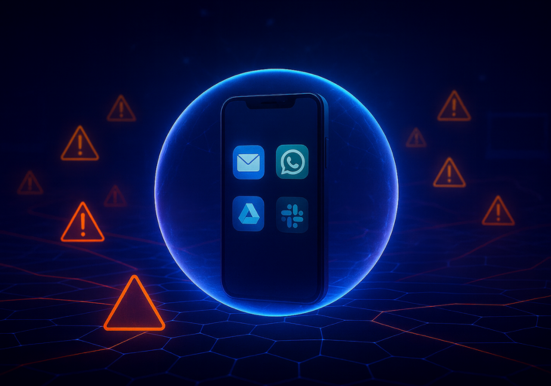
Symmetrium provides a fully isolated work environment streamed from the organization’s infrastructure, with zero data ever stored on the physical device. For high-sensitivity field use, this architecture aligns naturally with operational constraints:

  • No enrollment, no agents, no access to personal data
  • A separate operational identity with full policy enforcement
  • Ability to run apps like WhatsApp, Telegram, Facebook and Instagram inside the workspace with compliance logging
  • Native performance that matches how operatives already communicate

This combination—security, compliance, and natural UX—made it a strong candidate for evaluation.

Inside the Pilot: Testing a Controlled Intelligence Workspace

During the pilot, the agency deployed 10 virtual mobile devices, each providing a secure workspace accessible from a personal phone. The environment included:

  • A dedicated operational WhatsApp number for each workspace
  • Secure messaging with organization-level visibility
  • An isolated workspace streamed from the agency’s server
  • Policy-controlled usage, including DLP features and access enforcement

All configurations aligned with the agency’s internal communication requirements.

How Operatives Used the System: Real-World Behavior at Real Volume

Over the course of the two-month pilot, operatives used the workspace heavily and consistently:

  • 4,435 messages exchanged
  • 986 chat sessions
  • 2,086 system connections
  • 210 average daily usage
  • 68 distinct conversation threads

Usage patterns mirrored everyday mobile behavior—fast exchanges, frequent reconnections, and natural communication flow. According to the pilot’s UX observations, participants reported a familiar, frictionless experience, similar to using their regular device. Support needs were minimal, and all issues were resolved quickly.

Validated Operational Capabilities: Privacy, Control, and Operator Effectiveness

Based on the pilot results, the agency validated several key operational advantages:

  • Sensitive data never touches the physical device—reducing risk during stops, searches, and inspections.
  • The operational identity remains fully separate and centrally controlled.
  • Messaging can be audited and governed without monitoring the personal phone.
  • Policy controls (screenshot, screen recording, copying, exporting) function reliably.
  • Operators retain full, native control over their day-to-day communication—adding contacts naturally and requesting new apps as operational needs evolve.
  • Approved tools and updates can be deployed across all workspaces within seconds, eliminating the back-office delays that typically slow down secure communication changes.
  • Teams can communicate and adapt quickly, without training or workflow disruption.

The pilot demonstrated that government field teams can operate securely on personal devices while maintaining both centralized governance and real-time operational flexibility.

Strategic Impact: A New Model for Government Field Mobility

The successful test of a single operational identity lays the foundation for broader applications across government field operations:

• Single-Identity Workflows: Secure Communications for Field Personnel

Validated during the pilot—ideal for teams operating across locations and departments.

• High-Sensitivity Operations: Separation That Protects the Operator

A secure work identity with zero data at rest and fully revocable access.

• Multi-Identity Operations: The Next Step Forward

While not part of the pilot, Symmetrium’s architecture supports evolving toward multiple isolated profiles and policy sets—important for agencies with complex operational roles.

What’s Next: Scaling Secure Mobility for Government Field Agencies

The agency is now analyzing expansion paths for additional field-focused operational groups. The pilot confirmed that a virtual mobile workspace can offer operations-grade security without compromising how personnel communicate or how field work is carried out.

Symmetrium continues to work with government field agencies to refine this model and support the next generation of secure mobile communication for high-sensitivity operational environments.
Symmetrium gives sensitive teams a secure mobile identity they can trust.
If you’re building capabilities for field, operational, or high-sensitivity teams, we’re here to help you evaluate whether this model is the right fit for your environment.
Reach out >>
Symmetrium and BlueFletch Partner to Simplify Clinical Mobility with Shared Device Platform

The new joint solution delivers sub-second access, zero-data-at-rest security, and measurable ROI, empowering clinicians to focus on patient care while reducing hospital costs by millions.

TEL-AVIV, Israel, Nov. 4, 2025 /PRNewswire/ — Symmetrium, a mobile productivity platform, today announced a strategic partnership with BlueFletch, a leader in shared mobile device management and single sign-on for frontline workers. The collaboration introduces the first device-agnostic, enterprise grade mobility solution for healthcare designed to scale mobile programs with easier, seamless, less time-consuming workflows that are also secure and compliant by design.

“Every minute clinicians spend logging into devices or hunting for missing equipment is time stolen from patients,” said Richard Makerson, CEO of BlueFletch. “BlueFletch and Symmetrium have eliminated that friction entirely. One badge tap delivers instant access to a complete, secure workspace. No passwords, no delays, no hunting for devices. Clinicians focus on patients instead of passwords, and hospitals get the ROI, security, and control that legacy mobility solutions have failed to deliver.”

Mobile devices are now indispensable across clinical workflows, yet outdated mobile management systems often force hospitals to take on additional costs, lose time, and face an unreasonably high risk of security issues. Clinicians routinely report time lost during their shifts due to login issues, reducing bedside time that is invaluable for providing high-quality care. Device loss remains high, with nearly one in four shared devices going missing each year, costing hospitals more than $750,000 annually in replacement and downtime. Meanwhile, the average healthcare data breach in the U.S. now costs  $10.22 million per incident, the highest of any sector.

“Our collaboration with BlueFletch is about providing the same native mobile experience clinicians are accustomed to in their everyday lives and expanding it to the medical setting,” said Omer Cohen, Founder & CEO of Symmetrium. “Together, we’re giving hospitals a simpler, faster way to equip every clinician with instant, reliable mobile access that is secure and compliant by design without the complexity and frustration that slows them down.”

The Symmetrium–BlueFletch partnership combines BlueFletch’s badge-tap single sign-on and shared device management with Symmetrium’s zero-data-at-rest Virtual Mobile Workspace, enabling instant, secure access across iOS devices. Hospitals adopting the joint solution can achieve annual savings of up to $1.1 million, thanks to reductions in device loss, downtime, and IT overhead. Clinicians benefit from sub-second authentication, uninterrupted session continuity, and a frictionless user experience that returns valuable time to patient care.

The Symmetrium–BlueFletch solution includes key features such as:

  • Device loss prevention & accountability: Reduce hardware overhead with Bring Your Own
    Device capability.
  • Badge-tap single sign-on: Clinicians authenticate instantly and resume sessions seamlessly
    on any device
  • Session resume: Minimize downtime. Clinicians can just badge in and pick up where they
    left off – sessions resume instantly.
  • Security & Compliance by design: No-data-at-rest, Centralized logging, archiving, and
    auditability for HIPAA-aligned governance.

About Symmetrium:

Symmetrium is a leading mobile productivity platform that streams a secure virtual mobile workspace to any device—iOS, Android, or desktop—with no data at rest, native mobile UX, and centralized control. Health systems use Symmetrium to safely enable clinical messaging, EHR access, imaging, and line-of business apps without MDM enrollment, agents, or device surveillance. The company serves organizations globally across healthcare, finance, and the public sector.

Learn more at www.symmetrium.io.

About BlueFletch:

BlueFletch delivers enterprise mobility solutions that eliminate friction for frontline workers on shared devices. The Atlanta, GA-based company serves healthcare, retail, manufacturing, transportation, logistics, and field services organizations with instant authentication, single sign-on, role-based unified experiences, and robust security. BlueFletch reduces device loss, eliminates password-related help desk tickets, and improves frontline team satisfaction and efficiency. With over 15 years of expertise, BlueFletch turns shared-device programs into measurable productivity and cost savings.

Learn more at www.bluefletch.com.

Symmetrium for Healthcare: clinical mobility without compromise

Deliver secure, compliant, and instant mobile access to every clinician – on any device.

Mobile workflows for the healthcare frontline care teams have  evolved — security alone isn’t enough. Symmetrium turns compliance into a built-in feature and productivity into the new standard for mobile access.

Why clinical mobility still falls short

Mobile access is now mission-critical in healthcare.
Clinicians rely on smartphones for communication, documentation, imaging, and care coordination — but most hospitals still struggle to make mobility work.

Across studies and frontline reports, the pain points are clear:

  • Long logins and broken sessions. Clinical users lose minutes every shift re-authenticating or restarting timed-out sessions.

  • Friction and fragmentation. Stacks of MDM, VPN, and containerized apps make mobile workflows slow and inconsistent.

  • No secure BYOD options for nurses and frontline teams. Security requirements often block personal devices entirely, despite demand for flexibility.

  • Device loss and management overhead. Hospitals face significant costs replacing and tracking shared devices each year.

  • Clinician frustration. When tools slow care, staff revert to insecure workarounds — texting colleagues, storing photos locally, or avoiding mobile tools altogether.

Mobility was meant to save time. Instead, it’s become another time sink.

A better foundation for clinical mobility

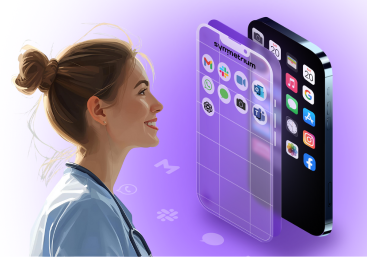
Symmetrium replaces the heavy, fragmented mobile stack with a single secure workspace — a virtual mobile OS streamed to any device.

It looks and feels like a native phone, but runs entirely inside the hospital’s secure network.
No data ever leaves the server. No MDM enrollment. No device control.

Clinicians get the simplicity of personal smartphones; IT gets full compliance and auditability.

The cost of poor mobility

Healthcare’s dependence on mobile access continues to grow, yet so do the inefficiencies:

  • Global research shows that most hospitals rate their mobile management capabilities below “effective”, citing weak access control, high downtime, and frequent device loss.

  • Half of respondents in multi-nation surveys say their organization lacks core features like remote lock, real-time tracking, or audit logging.

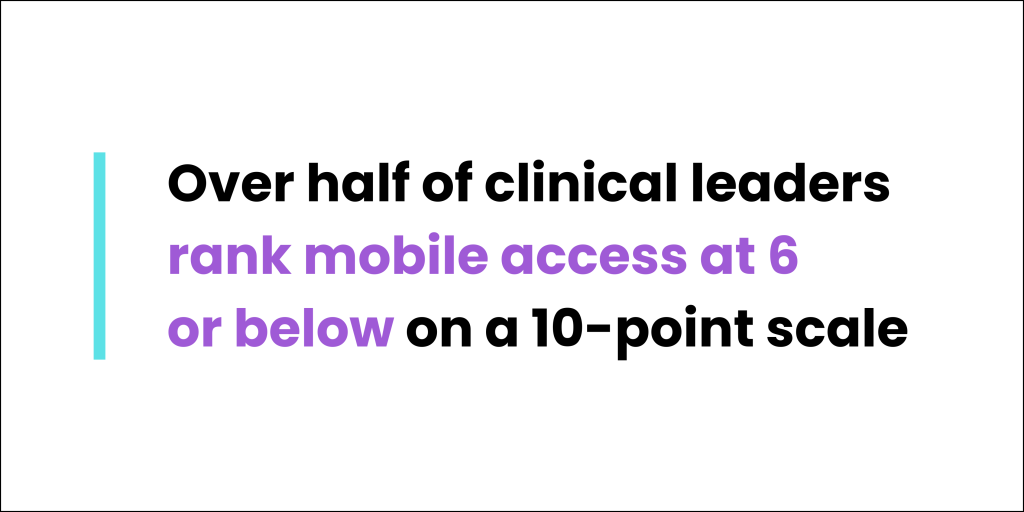
  • User satisfaction remains low, with over half of clinical leaders ranking mobile access at six or below on a 10-point scale.

  • The financial impact is substantial — between lost productivity, downtime, and device replacement, many health systems lose hundreds of thousands of dollars per year in preventable overhead.

Symmetrium’s approach addresses the root cause: complexity. Instead of fixing the stack, it replaces it with a single, seamless workspace.


Designed for every healthcare use case


1. Shared devices for nurses and shift-based staff

Enable multiple clinicians to share devices securely with instant badge-tap login and session resume. Each user’s workspace follows them across shifts and devices.

Outcome: Eliminates long logins, removes shared credentials, reduces device loss, and gives nurses back minutes for patient care.

2. BYOD at scale

Allow clinicians to use personal smartphones for EHR, secure messaging, and imaging — with full privacy. No agents, no data left behind.

Outcome: Expands access while reducing capital spend and finally makes BYOD viable for frontline staff.

3. Multi-facility physician access

Physicians covering multiple hospitals or clinics can use one device and one workspace for all systems.

Outcome: Fewer devices, simpler workflows, consistent compliance.

4. Compliant clinical messaging

Run Teams, WhatsApp, Signal, TigerConnect, Halo, or Spok directly inside the workspace.

Outcome: Faster consults and discharges, full message archiving, and protected personal privacy.

5. Secure camera and content capture

Capture wound photos and videos within the workspace and upload directly to the EHR.

Outcome: Better documentation and zero risk of PHI leakage.

6. Virtual rounding and cross-team consults

Enable secure messaging and teleconsults between teams or facilities.

Outcome: Faster time-to-decision and smoother coordination.

7. Temporary and contractor access

Provide short-term compliant mobile access for rotating staff — without enrollment or manual setup.Outcome: Quick onboarding, one-click revocation, consistent compliance.


Compliance that runs in the background

Every Symmetrium workspace automatically enforces HIPAA and GDPR requirements:

  • Zero data at rest
  • End-to-end encryption and audit trails
  • Screenshot, recording, and copy-paste blocking
  • Seamless integration with identity providers and conditional access

Compliance isn’t a separate process — it’s baked into the architecture.


A simpler, smarter way to mobilize care

Value PillarReal-World Impact
⏱️ ProductivityFaster access, shorter logins, fewer interruptions
💰 Cost SavingsSmaller device fleets, fewer replacements, fewer IT tickets
🔒 Risk AvoidanceZero PHI on devices, full auditability, lower breach exposure
📱 AdoptionNative mobile UX clinicians actually enjoy using
🧩 Compliance by DesignAlways-on HIPAA/GDPR posture with centralized control


About Symmetrium

Symmetrium is a clinical mobility platform that streams a secure virtual mobile workspace to any device — with zero data at rest, native mobile UX, and centralized control.
Trusted by healthcare, finance, and public sector organizations, Symmetrium turns mobile access from a compliance headache into a productivity advantage.


Ready to see it in action?

Experience how Symmetrium gives clinicians instant, compliant mobile access — without controlling the device.

👉 Book a live demo or explore our Demo Hub to watch product walkthroughs on demand.

How to Achieve a Fully Secure Mobile Workspace for Remote Teams

The mobile workforce is no longer an edge case, it’s the default. From healthcare professionals moving between sites to consultants checking messages on the go, mobile devices are now central to how business gets done. But they’re also central to how data gets lost.

Most organizations are still trying to secure mobile work the way they secured laptops in the early 2010s:  layering control tools on top of each other: MDM for governance, MTD for threats, VPNs for access, browser wrappers for isolation. The result? A stack that’s difficult to manage, frustrating to use, and still leaves data at risk.

Symmetrium offers a different approach: a secure mobile workspace that delivers zero-trust access, full compliance, and native mobile performance, without installing anything on the device or touching personal data. It’s called a Virtual Mobile Workspace (VMW), and it changes the equation for mobile security.

The hidden cost of managing devices

Enterprise mobile security stacks are often made up of overlapping tools:

  • Mobile Device Management (MDM) for control and compliance
  • Mobile Threat Defense (MTD) or EDR for endpoint monitoring
  • VPNs or ZTNA for secure connectivity
  • Remote Browser Isolation (RBI) to limit web-based threats

Each of these tools adds friction – to users, to IT, and to overall risk management. Admins are left juggling enrollment flows, configuration rules, and personal privacy boundaries. Meanwhile, employees resist tools that inspect their personal apps and behavior. And even with all this overhead, security gaps persist.

Workspace isolation, not device control

A fully secure mobile workspace doesn’t start with the device. It starts with a clean separation of work and personal environments, enforced by design, not policy workarounds.

Symmetrium’s Virtual Mobile Workspace (VMW) is streamed securely from the enterprise cloud or data center to any mobile device. It behaves like a native mobile OS, but lives entirely off the device, with:

  • Zero data at rest
  • No device enrollment or MDM
  • No agents or app wrapping
  • Full enterprise visibility and control

Users access their work environment through a low-latency stream. The mobile experience feels familiar: camera, calls, messaging all supported – but everything stays contained within the workspace. Personal apps remain untouched, and IT teams never see or control the personal side of the device.

Learn how Symmetrium compares to MAM approaches

Why MAM and browser isolation ≠ mobile-native workspace

Mobile Application Management (MAM) and browser isolation are often positioned as lightweight alternatives to full MDM. But neither approach delivers the functionality, compliance assurance, or user experience of a true mobile workspace.

CapabilityMAMBrowser Isolation (RBI)Symmetrium Virtual Mobile Workspace
Native mobile experiencePartial per-appWeb-onlyFull OS-level mobile UI
Data-at-rest riskApp data storedNoneZero data at rest
App & feature supportWrapping requiredLimitedFull mobile app support
Work-life separationApp scope onlyNoneWorkspace-level isolation
BYOD user privacyPersonal device inspectionBrowser-onlyNo enrollment, full privacy
Compliance enforcementPer-app rulesLimited loggingAudit-ready policy control

Symmetrium’s approach enables full separation of work and personal environments, with centralized policy enforcement and native mobile UX, all without installing anything on the device.

Control, compliance, and privacy – built in

A secure mobile workspace isn’t a tradeoff between IT control and user privacy. It’s a way to achieve both at once. Symmetrium brings everything together into one managed, isolated environment.

Security & Compliance

  • Data never touches the endpoint
  • Mobile DLP blocks screenshots, copy/paste, recordings
  • Messaging archiving and workspace-dedicated phone numbers
  • Built-in web filtering and audit logging

Learn more about Zero Trust standards

IT Management

  • No need for MDM enrollment or setup flows
  • Works across Android and iOS with centralized control
  • Remote app deployment and workspace patching
  • Supports conditional access and IDP integration

User Experience

  • Native mobile interface through low-latency encrypted streaming
  • Native mobile access to camera, calling, keyboard 
  • Clean separation between work and personal data
  • No device control, no user resistance

Where secure mobile workspaces shine

Symmetrium’s Virtual Mobile Workspace is especially well-suited for:

BYOD environments

Symmetrium supports secure mobile access on any personal device, without enrollment, surveillance, or intrusive agents. Users maintain privacy. IT maintains control.

Shared devices in high-turnover industries

In healthcare, logistics, or field work, shared mobile devices create complexity. With VMWs, employees can access their personalized workspaces from any device, with no need for kiosk mode or reconfiguration.

Third-party access

Contractors, advisors, and partners can be granted secure mobile access in minutes. There’s no setup, no teardown, and no risk of data lingering on the device.

Explore mobile workforce management use cases

Symmetrium’s model supports compliance with global frameworks such as GDPR and the HIPAA Security Rule by enforcing isolation, logging, and data minimization by default.

Simplifying the stack, without compromise

Instead of adding to the stack, Symmetrium simplifies it:

  • No MDM to configure
  • No VPN tunnel to maintain
  • No browser wrappers or virtual desktop infrastructure
  • No endpoint threat agents

Everything work-related: apps, messaging, data, policies – lives inside the workspace.

This not only reduces IT overhead, but also creates consistency across all device types and user scenarios.

Read: MDM vs. MAM – Everything You Need to Know

Best practices for mobile-secure remote teams

If you’re managing a remote or hybrid mobile workforce, here are four key principles to implement:

  • Stream the workspace instead of storing data on the device
  • Enforce policy inside the workspace, not at the OS level
  • Avoid agents and device inspection to preserve user trust and simplify BYOD
  • Standardize your approach across personal and corporate-owned devices

See our mobile security best practices

FAQs

How can remote teams ensure compliance with global data protection laws?
Virtual Mobile Workspaces allow you to contain all business activity in a controlled, isolated environment, with no data stored on the device.

What are some cost-effective mobile security solutions for small businesses?
Symmetrium eliminates the need for multiple tools like MDM, VPN, or EDR, reducing cost and complexity while improving compliance.

How do I educate non-technical staff about mobile cybersecurity risks?
Instead of relying on training alone, you can remove the risk altogether by separating work and personal activity using a secure workspace.

Which remote collaboration tools are most secure for mobile devices?
The most secure approach is to run all collaboration tools, messaging, file sharing, video calls, inside a centrally managed workspace.

How does geolocation impact mobile workspace security?
You can apply location-based policies (via conditional access) to manage who can access the workspace, when, and from where.

What should a remote incident response plan include for mobile threats?
With workspace streaming, containment is simple: revoke access, lock the session, and review audit logs, all without touching the device.

Mobile work deserves real workspaces. Not patchwork tools. 

Symmetrium is redefining how mobile work is secured, without compromising privacy, performance, or compliance. With Virtual Mobile Workspaces, your data stays off the device, your users stay productive, and your IT team stays in control.

Whether you’re supporting a BYOD program, enabling secure field operations, or managing sensitive communications across mobile endpoints, this is how secure mobile work gets done.

👉 Book a live 20 min demo   
👉 Explore our self-serve demo hub

Best Practices for Mobile Data Protection in 2025

Mobile workforces demand modern data protection

As enterprises lean further into mobility, data increasingly lives and moves across smartphones, tablets, and hybrid endpoints. While these devices unlock convenience and agility, they also widen the attack surface. From real-time messaging to app-based workspaces, sensitive corporate information is flowing through mobile endpoints with limited oversight.

But traditional security methods aren’t keeping pace. Cloud backups, rogue apps, and personal-device behavior bypass outdated MDMs and fragmented agent-based approaches. Meanwhile, regulatory pressure around mobile data privacy is intensifying. In the U.S., state-level regulations around mobile privacy are multiplying, while international frameworks like GDPR and the upcoming EU AI Act are reshaping compliance expectations.

The solution isn’t more monitoring. It’s more control. Symmetrium introduces a data-first approach to mobile data protection: one that isolates sensitive data inside a secure, ephemeral workspace. No data at rest. No personal-device compromise. Total enterprise control.

The hidden risks driving modern mobile data protection

Business-critical data now flows through mobile apps, chat threads, and downloaded attachments. Whether it’s healthcare PHI, financial reports, or authentication credentials, mobile endpoints expose high-value information in everyday use.

Yet organizations often overlook how easily data can leak: screenshots, copy/paste, unsanctioned backups, and app permissions create exposure far beyond malware. Personal devices increasingly mix with corporate access, creating invisible risks that are hard to track or audit.

Outdated operating systems, cloud syncing, and public Wi-Fi all add to the vulnerabilities. These risks are especially concerning in industries with sensitive and regulated data, where mobile data exposure can carry legal and financial consequences.

Read industry analysis on mobile device security

What types of mobile data are at risk?

Mobile risks aren’t limited to downloaded files. Data can live in transient spaces:

  • Authentication data: tokens, cookies, access credentials stored by apps or browsers. These are often cached in autofill systems and can be harvested through phishing or compromised apps.
  • Cloud-based attachments: PDFs, signed docs, contracts, spreadsheets. These files can be synced across services or left accessible via file managers.
  • Business communications: chat logs, voice recordings, calendar entries. Messaging apps and collaboration tools may store sensitive information temporarily or indefinitely.
  • Personal-enterprise mix: cross-contamination between personal and corporate apps. For example, sharing files via personal cloud apps or using the same messaging platform for both contexts.
  • Shadow data: cloud-synced versions stored outside enterprise control. Often the result of third-party integrations or automatic backups.

Even with MDMs or mobile encryption in place, these categories remain exposed. App-level DLP can’t stop screenshots or clipboard actions. Mobile data protection requires visibility and control inside the workspace itself.

See our mobile security best practices

Identifying current threats to mobile data

Recent research indicates that over half of mobile devices in use globally operate on outdated or unsupported systems, exposing them to critical vulnerabilities. Additional mobile security reports outline the key risk factors:

  • App-layer leakage: Sideloaded or vulnerable apps accessing sensitive content. Many apps over-request permissions and access content they shouldn’t.
  • Backup risks: Unencrypted auto-sync to iCloud, Google Drive, or other cloud storage. This can inadvertently expose sensitive documents outside the enterprise.
  • Outdated OSs: Unsupported devices that can’t receive security patches. These devices are prime targets for attackers.
  • Human behavior: Screenshots, file exports, unauthorized app usage. These actions often bypass enterprise controls entirely.
  • Lack of visibility: No unified audit trail or policy enforcement. Without proper logging, risky behavior often goes undetected.

The problem is compounded by remote and hybrid work environments, where devices are more likely to be unmanaged, shared, or out of compliance.

These risks aren’t solved by more endpoint agents or heavier device control. Instead, they call for a workspace-level solution: one that governs mobile activity without touching the personal OS.

Explore 2025 Global Threat Report by Zimperium

Best practices for mobile data protection

To truly protect mobile data, organizations must shift from reactive defense to proactive containment. Here are 2025’s best practices:

Data isolation
Eliminate data at rest by delivering content inside a Virtual Mobile Workspace (VMW) with no persistence on the local device. No local storage = no lateral exposure. This ensures that even if a device is lost, stolen, or compromised, enterprise data cannot be extracted.

Access control
Enforce granular policies within the workspace: block copy/paste, screenshots, and screen recording. Apply device-agnostic controls tied to identity and workspace state. This enables adaptive risk mitigation regardless of device ownership or operating system.

Compliance & audit
Log every workspace session and action. Assign enterprise-level identities and phone numbers. Provide export-ready audit trails. This simplifies regulatory reporting and internal investigations.

User privacy
Avoid MDMs, agents, or surveillance of personal environments. Symmetrium protects business data without touching the personal OS, ideal for BYOD and shared-device settings.

Dynamic session policies
Adjust access and policy enforcement in real-time based on contextual signals: device posture, location, time of day, and more. This ensures that the workspace responds to risk as it evolves.

Learn how Symmetrium transforms mobile DLP
Read Gartner Peer Insights on Mobile Data Protection Solutions

FAQs: What leaders are asking about mobile data protection

Can mobile data protection solutions help businesses achieve regulatory compliance?
Yes. By isolating sensitive data, logging user actions, and enforcing usage policies, workspace-first solutions like Symmetrium support HIPAA, GDPR, and other mandates.

How does cloud backup impact the security of my mobile data?
If data is stored locally, it may be synced to personal or unmanaged clouds. Eliminating local data through VMW ensures nothing can leak via cloud sync.

Should businesses allow personal devices to access corporate data?
Yes, with VMW, IT controls data flow without compromising privacy.

What role does artificial intelligence play in mobile data security?
AI can aid threat detection, but true protection requires hard boundaries: controlling where data lives, how it’s used, and what actions are allowed.

Are there specific threats unique to wearable devices?
Yes. From Bluetooth sync to ambient recording and sensor leakage, wearables introduce new access vectors. Symmetrium’s workspace boundaries mitigate that risk.

How can IT enforce mobile privacy without overstepping?
Workspace isolation ensures full control over enterprise data without monitoring or interfering with the personal environment—preserving trust and usability.

Can mobile data protection improve user experience?
Yes. By avoiding invasive controls and streamlining access through a unified workspace, users benefit from speed, consistency, and clarity.

Conclusion: Redefining mobile data protection in 2025

Protecting mobile data in 2025 means preventing exposure—not just detecting threats. That requires containing enterprise data inside a secure, controlled workspace, not on personal devices.

Symmetrium’s Virtual Mobile Workspace provides the foundation: zero data at rest, full compliance, and policy enforcement by design. It’s the mobile data protection solution built for the privacy-first, regulation-ready, hybrid workforce.

As mobile-first becomes the enterprise norm, mobile data protection must evolve from traditional control tactics to strategic containment. Virtual Mobile Workspaces are not just a security tool—they’re the new perimeter.

👉 Book a live 20 min demo   
👉 Explore our self-serve demo hub

Symmetrium Wins “Best Enterprise Mobile Threat Defense” at Global InfoSec Awards 2025

San Fransisco, April 28, 2025 — We’re proud to announce that Symmetrium has been awarded Best Solution – Enterprise Mobile Threat Defense by Cyber Defense Magazine, as part of the 2025 Global InfoSec Awards at RSA Conference.

The Global InfoSec Awards are now in their 13th year, recognizing companies with unique, forward-looking approaches to today’s toughest cybersecurity challenges. Winners are selected by a panel of certified security professionals, looking for innovation that’s effective, practical, and genuinely different.

Symmetrium stood out for our approach to mobile security—designed from the ground up for enterprises that demand control without compromise:

  • No data at rest
  • Native, frictionless user experience
  • IP-level access enforcement
  • Privacy-first design for executive use
  • Full visibility and control—without invasive agents

“We built Symmetrium for security leaders who are tired of patchwork mobile controls and poor UX. This award validates the architecture we believe should become the standard.”

Omer Cohen, CEO of Symmetrium

The full list of winners can be found at cyberdefenseawards.com.

Thanks to Cyber Defense Magazine for the recognition—and to the security leaders pushing this category forward.

Symmetrium Shortlisted for Best DLP Solution at SC Awards Europe 2025

We’re thrilled to announce that Symmetrium’s Zero-Trust Mobile Access has been shortlisted for Best Data Leakage Prevention (DLP) Solution at the SC Awards Europe 2025.

This isn’t just recognition—it’s real validation from one of the most respected cybersecurity awards globally. The SC Awards don’t isolate categories into silos. Finalists compete across the entire stack—identity, cloud, threat detection, governance, and more. So being shortlisted here means one thing: Symmetrium’s approach to mobile access isn’t just different—it’s setting a new standard.

A Seat at the Table with the Industry’s Best

What makes this even more exciting? We’re sharing the SC Awards stage with industry leaders like Thales, CrowdStrike, Wiz, IBM, and Trustpilot—all shortlisted in other categories. These aren’t just names. They’re driving the future of cybersecurity. Being recognized alongside them confirms that Symmetrium’s rethinking of mobile data protection isn’t just timely. It’s essential.

How We Got Here

As workforces become more mobile, traditional security models fall short. Symmetrium was built for this shift. We deliver native mobile experiences without storing any data on-device, removing the risk at the root. No VPNs. No workarounds. Just secure, zero-trust access designed for the real world.

Zero-Trust Mobile Access lets teams work natively and securely on mobile devices—without exposing sensitive data or relying on clunky workarounds. That’s why we’re proud to be recognized in the DLP category. Our mission is to stop leaks before they happen, even when devices are lost, stolen, or compromised.

June 3rd is Coming

Winners will be announced on June 3rd at the Leonardo Royal Hotel St. Paul’s in London. Regardless of the outcome, this moment is a celebration—for our team, our customers, and anyone who believes that mobile access should be both secure and seamless.

Thanks to SC Media and the independent panel of judges for the recognition—and congrats to all the other finalists.

See why zero-trust mobile access is turning heads at this year’s SC Awards. Book a demo today.

About Symmetrium

Symmetrium is a zero-trust, mobile data governance and security platform designed to turn any mobile device into a virtual extension of the enterprise, inheriting all its compliance, security and IT protocols. Symmetrium keeps no data at risk by allowing no data at rest, all while delivering users a completely native mobile access solution that can be quickly and easily deployed.

Media Contact:

Roni Dagan
roni@symmetrium.io


Symmetrium Introduces New Partner Program to Enhance Resell Opportunities

TEL AVIV, Israel, Oct. 13, 2024 /PRNewswire/ — Symmetrium, the zero-trust, mobile data governance, and security platform designed to turn any mobile device into a virtual extension of the enterprise, inheriting all its compliance, security and IT protocols, is excited to announce the launch of the new Symmetrium Partner Program. The new program is open to all channel partners, including resellers, distributors and MSPs.

Through this program, Symmetrium provides a comprehensive suite of resources to deliver a robust zero-trust mobile security framework to protect the data of their customers and empower its partners to increase their business outcomes.

“Symmetrium believes that partners are a core component of our business success, enabling us to reach more customers and meet the global demand for our innovative corporate zero-trust mobile security solution,” said Omer Cohen, founder and CEO of Symmetrium. “With mobile security a key vulnerability for corporate networks in the era of hybrid working, we look forward to collaborating with our partners worldwide to help solve the threats businesses face from remote access to their networks. We look forward to expanding our partner ecosystem and helping our partners deliver stellar services and customer experiences.”

Symmetrium Partners are eligible for a suite of additional benefits in the areas of sales, marketing and support, including a deal registration program, lead sharing, a dedicated marketing manager, marketing resources and a comprehensive enablement plan.

The new program offers partners access to Symmetrium’s fully managed support services, designed to reduce the resources required by partners, allowing them to focus on delivering exceptional customer experiences.

For more information and to sign up for Symmetrium’s partner visit https://symmetrium.io/partners.

About Symmetrium

Symmetrium is a zero-trust, mobile data governance and security platform designed to turn any mobile device into a virtual extension of the enterprise, inheriting all its compliance, security and IT protocols. Symmetrium keeps no data at risk by allowing no data at rest, all while delivering users a completely native mobile access solution that can be quickly and easily deployed.

Media Contact:
Roni Dagan
roni@symmetrium.io


Symmetrium is the First Mobile Security Solution to Control Mobile Access and Web Filtering at the IP Layer

TEL AVIV Israel, July 10, 2024 — Symmetrium, the zero-trust, mobile data governance, and security platform, has achieved a significant milestone by becoming the first mobile  security solution to control mobile access and web filtering using IP addresses, without the need for complex management configuration using VPNs.

Symmetrium’s unique approach uses Virtual Mobile Devices (VMDs), with static IP addresses, that reside within the security of the corporate network. When a mobile device accesses the corporate network using Symmetrium, the static IP address of the VMD attaches to the device, instead of the dynamic IP provided by the mobile carrier. This dramatically simplifies the challenge of managing mobile access to the corporate network environment, allowing CISOs and IT Leaders to restrict access to a small set of static addresses. 

Symmetrium’s Web Filtering also focuses on the IP Layer, enabling security teams to both block and allow access to specific websites. This allows for the full separation of work-related and personal online activity, maintaining full employee privacy for non-corporate online activities. This is unlike current VPN and DNS solutions, which capture all website activity of users, raising concerns regarding employee privacy particularly in a BYOD environment. 

“We are the first solution to allow the control of mobile access and web filtering through a static IP, without the need for the complex management and configuration of a VPN,” says Omer Cohen, founder and CEO of Symmetrium. “Securing mobile access at the IP Layer is part of the Symmetrium Mobile Zero Trust Approach, which implements least-privilege access by granting users and devices and their networks the minimum level of permissions necessary to perform their tasks.”

Symmetrium’s seamless, completely native mobile experience ensures sensitive data is accessed virtually and therefore never comes on the user’s actual device. The result is a reduced attack surface to ensure that data remains secure and is never put at risk.


About Symmetrium

Symmetrium is a zero-trust, mobile data governance and security platform designed to turn any mobile device into a virtual extension of the enterprise, inheriting all its compliance, security and IT protocols. Symmetrium keeps no data at risk by allowing no data at rest, all while delivering users a completely native mobile access solution that can be quickly and easily deployed.


Media Contact:

Roni Dagan
roni@symmetrium.io


Symmetrium’s Launches Instant Messaging (IM) and SMS Data Protection Solution to Eliminate Corporate Security and Compliance Risks

TEL AVIV Israel, November 8, 2023 — Symmetrium, the zero-trust, mobile data governance, and security platform designed to turn any mobile device into a virtual extension of the enterprise, inheriting all its compliance, security and IT protocols, has unveiled its Instant messaging (IM) and SMS data protection solution, which eliminates the corporate security and compliance risks associated with IM usage by employees.

With messaging apps now part of daily life in many workplaces, Hackers can exploit their vulnerabilities and use phishing texts to infiltrate data systems, increasing the risk of ransomware and other cyberattacks.

By integrating with existing email security tools Symmetrium’s new IM and SMS solution enables organizations to instantly protect against these security threats by deploying virtual mobile devices within the organization’s network that provide users with dedicated work mobile numbers (which act as unique identifiers) without the need for dedicated devices. This ensures protection against SMS phishing (Smishing), preventing fraud and fraudulent links by scanning every message and integrating with existing email security tools before delivery to end users.

Symmetrium also mitigates compliance risks by capturing and storing all work-related messaging, instantly creating an agentless IM and SMS archive. This allows organizations to constantly meet regulatory data requirements imposed on their sector.

“The rapid rise of corporate IM and SMS usage has made it far more challenging for businesses to ensure corporate IT security and preserve electronic communications for regulatory purposes,” says Omer Cohen, founder and CEO of Symmetrium. “We solve these two challenges by delivering a native mobile experience for end users while allowing organizations to deploy a minimal resource allocation solution, which eliminates the need for costly device management solutions.”

When Symmetrium’s VMDs are accessed by employees using their mobile phones, they act as extensions of all organizational security and compliance policies using end-to-end encrypted streaming. The result is a completely secure but native mobile experience with seamless deployment and management.


About Symmetrium

Symmetrium is a zero-trust, mobile data governance and security platform designed to turn any mobile device into a virtual extension of the enterprise, inheriting all its compliance, security and IT protocols. Symmetrium keeps no data at risk by allowing no data at rest, all while delivering users a completely native mobile access solution that can be quickly and easily deployed.


Media Contact

Roni Dagan
roni@symmetrium.io


close-tag

We’re proud to be the ones making TPRO, CISO, IT and vendors - happy

by ramping up zero-trust mobile access.

Explore all use cases now